Why Am I Overthinking Everything?
15 Honest Reasons — And How to Actually Stop
If your brain has ever turned a two-word text into a 45-minute psychoanalysis session at midnight, this one’s for you.
“Why am I overthinking this?” — if you’ve said that to yourself at 2 a.m. while replaying a conversation from three days ago, welcome. You are in very good company.
Here’s something nobody tells you upfront: overthinking isn’t a character flaw. It’s not a sign you’re weak, dramatic, or “too much.” It’s actually your brain trying — really, really hard — to protect you. The problem? It doesn’t know when to clock off. It’s like having a security guard who never takes a break, never sits down, and insists on treating every mildly awkward email the same way they’d treat an actual break-in.
In this guide, we’re going deep on the real reasons why you overthink everything — from anxiety and attachment styles to 3 a.m. doom scrolling and comparing your life to someone’s filtered highlight reel. We’ll cover what happens to your brain at night, why some of us are wired this way more than others, and what actually helps — because “just stop thinking about it” is the least useful advice ever invented by anyone.
- What overthinking actually is (and what it isn’t)
- 15 real, honest reasons you overthink everything
- Why overthinking gets so much worse at night
- Overthinking vs anxiety vs depression — a clear comparison
- Why you overthink texts, relationships, and what people think
- Overthinking and your body image, career, and future
- 12 Amazon products that genuinely support a calmer brain
- FAQs — your most-asked questions, answered honestly
- What to actually do about it (a practical summary)
First — What Even Is Overthinking?
Before we get into the “why,” it helps to know what we’re actually talking about. Overthinking is when your brain takes a thought and refuses to let it go — running it through every possible outcome, scenario, interpretation, and worst case until you’re exhausted and no closer to clarity than when you started.
It comes in two main flavors, and most of us cycle between both:
- Rumination — replaying the past. That cringy thing you said in 2022. The argument you handled badly. The text you probably worded wrong. The meeting where you went quiet when you shouldn’t have.
- Worry — projecting into the future. What if you fail? What if they don’t like you? What if you choose wrong? What if everything falls apart and it’s your fault?
Both feel incredibly urgent. Both are exhausting. And neither one actually solves anything — which is the cruelest part of the whole ordeal. You spend hours “thinking through” a problem and end up right back where you started, only more tired.
“Overthinking is the art of creating problems that weren’t there in the first place.”
— widely attributed, endlessly accurate
The key difference between productive thinking and overthinking is output. Productive thinking leads somewhere — a decision, a plan, a resolution. Overthinking loops. If you’ve been “thinking through” something for 45 minutes and you’re still in the same place, you’ve crossed the line.
15 Real Reasons Why You’re Overthinking Everything
Most of these won’t surprise you. But seeing them laid out clearly — and understanding the why behind each — can be genuinely disarming. Knowledge is the first step to not letting these patterns run your life.
Your amygdala — that small almond-shaped structure deep in your brain — is essentially a 24/7 security guard trained in a much more dangerous era. Back when threats were physical (predators, famine, rival groups), constant vigilance kept humans alive. Now it treats a vague text from your partner with the same neurological urgency as a saber-toothed tiger.
This is called negativity bias, and it’s not a bug — it’s an ancient feature. The brains that survived were the ones that worried. You’ve inherited millions of years of premium-grade catastrophizing. The problem isn’t that your brain is broken. It’s that it hasn’t updated its software for modern life.
Overthinking and anxiety are so deeply intertwined they’re basically the same monster in different outfits. Anxiety creates a persistent sense of urgency — that restless, low-grade “something is wrong” feeling — and your mind scrambles to figure out what. The result is a thought spiral that feels like problem-solving but is actually just spinning in place, burning fuel.
If you notice overthinking and anxiety happening together — racing thoughts, tightness in your chest, a low-key dread you can’t quite name — you’re not imagining things and you’re not being overdramatic. Your nervous system is in a heightened state, and your thoughts are following its lead.
Anxiety doesn’t always look like panic attacks. Sometimes it looks like lying awake for two hours replaying a conversation, or spending twenty minutes re-reading a message before hitting send.
Perfectionism isn’t about being organized or high-achieving. It’s really about believing that a “wrong” choice will have severe, lasting consequences — that making a mistake says something permanent about your worth as a person. Sound familiar?
When the stakes feel impossibly high (even when, objectively, they probably aren’t), your brain refuses to commit to a decision. So you overthink it. Then overthink the overthinking. Then worry that you’re the kind of person who overthinks. It’s turtles all the way down.
You’re not indecisive or weak. You’re terrified of being imperfect in a way that can’t be undone — and that fear is keeping you frozen in the thinking stage instead of the doing stage.
Here’s the thing: so does every other human on earth. We are fundamentally social animals — being accepted by our group once literally meant survival. Rejection and judgment still trigger something primal, even when the stakes are objectively much lower than they were on the savanna.
But here’s what the research consistently shows: other people think about you far, far less than you think they do. This is called the spotlight effect — we assume we’re center stage in everyone else’s mental theater at all times. In reality? They’re all in their own heads too, overthinking their own stuff, worrying about their own impression management.
The colleague who witnessed your stumbled words in a meeting? They’ve already forgotten. The person who saw you trip on the pavement? They don’t remember. Your brain has assigned you the starring role in a show nobody else is watching.
Did I say the wrong thing? Did that come across badly? Why did they respond like that — what did it actually mean? Were they being cold, or just busy? Should I follow up, or would that be weird? And why did I trail off like that at the end?
You’re not just remembering a conversation; you’re cross-examining it. Pulling apart every word, every pause, every facial expression you can still picture. Looking for evidence about how you were perceived, whether you messed up, what’s coming next as a consequence.
This usually comes from a place of genuine emotional sensitivity — you care about your relationships and how you show up in them. It also comes from past experiences where things did go wrong after a conversation, training your brain to treat every interaction as potentially loaded with hidden meaning.
Why am I overthinking and comparing myself to others online? Because you’re using an internet that was designed — deliberately, by very smart engineers — to be maximally engaging and just slightly destabilizing. Comparison keeps you scrolling. Dissatisfaction keeps you coming back.
When you see someone’s promotion, relationship, holiday, new apartment, or body, your brain doesn’t say “that’s one carefully filtered data point from one chapter of their complicated life.” It says “why not me?” And then the spiral starts — about your career, your choices, your body, your relationship status, your timeline.
You’re not weak for falling into this pattern. You’re responding exactly as the product intended. The algorithm isn’t your friend; it’s a slot machine that runs on your insecurity.
If you find yourself overthinking relationships and love — reading into texts, wondering constantly where you stand, catastrophizing silences, interpreting “okay” as a hidden sign of distance — there’s a good chance your attachment style is doing a lot of the heavy lifting here.
Anxious attachment is typically shaped by early relationships that felt inconsistent or unpredictable — where love and attention felt conditional or hard to rely on. Your nervous system learned to stay on high alert for signs that connection was being withdrawn, because sometimes it was. That vigilance made sense then. Applied to adult relationships, it creates a lot of suffering.
This isn’t “being crazy” or “too needy.” It’s a nervous system pattern that learned to scan for relational threats the same way anxiety scans for danger. Understanding this — really understanding it, not just knowing the words — can be genuinely life-changing.
Sometimes overthinking isn’t a dysfunction at all — it’s a completely understandable response to real uncertainty. A career crossroads with no obvious right answer. A relationship you love but aren’t sure about. A health concern you’re waiting on answers for. A future that feels genuinely, legitimately unclear.
Overthinking in these situations is your brain’s way of trying to prepare for all possible outcomes, because it can’t stand the idea of being caught off guard. The deep cruelty is that real uncertainty cannot be resolved by thinking harder — only by gathering more information, taking action that generates data, or accepting that some things exist outside your control.
Sleep deprivation literally impairs your prefrontal cortex — the part of your brain that says “okay, this thought is disproportionate and we can let it go.” Without that rational moderator online, your emotional brain runs unsupervised. And an unsupervised emotional brain is remarkably creative when it comes to worst-case scenarios.
This is why overthinking at night is so particularly brutal. By 11 p.m., your rational override is running on fumes. Whatever thought gets in at midnight gets to stay, make itself comfortable, and invite all its friends. The 2 a.m. version of any problem is always, always more catastrophic than the 10 a.m. version of the same problem.
If you were raised to be “the responsible one” — the emotional caretaker, the peacekeeper, the one who smoothed things over — or if you grew up in an environment where things could go wrong if you weren’t careful enough, your brain learned that vigilance equals safety. Overthinking became a feature, not a bug. You overthink because at some point in your life, overthinking was genuinely how you kept the peace or prevented bad things from happening.
That pattern made a lot of sense then. It’s just that your brain didn’t get the memo that the situation has changed.
This is the one nobody wants to hear, so we’ll say it plainly: sometimes we overthink because staying in our heads is safer than sitting with an emotion we’d really rather not feel. Grief. Loneliness. Shame. Fear of abandonment. Deep disappointment in yourself or someone else.
If you’re busy analyzing and problem-solving and theorizing, you don’t have to actually feel it. Overthinking as emotional avoidance is incredibly common and incredibly sneaky — because it looks and feels like productivity. It feels like you’re doing something useful. But often, the only way through is through. The thought spiral ends when the feeling finally gets some airtime.
Constant connectivity trains your brain to stay “on” — always scanning for new input, new updates, new potential threats or social information. Every notification is a tiny interruption, a tiny dopamine hit, a small re-engagement with your social world and all its complexity. Over time, your brain loses the ability to genuinely idle.
Late-night phone use compounds this dramatically. Blue light suppresses melatonin. Social media content generates fresh material to ruminate on right before sleep. And the scrolling posture — passive, reactive, slightly anxious — is genuinely antithetical to the kind of calm needed to wind down an overthinking brain.
Overthinking and depression have a complicated, two-directional relationship. Depression can cause repetitive negative thinking — often called rumination — where your brain cycles through hopeless narratives about yourself, your history, or your future on a loop. And chronic overthinking, over time, can contribute to depression by keeping you trapped in negative thought patterns that reinforce a dark worldview.
If your overthinking feels less like anxious “what if” questions and more like a flat, heavy certainty that things are bad, that you’re the problem, that it won’t get better — that distinction matters. That’s worth taking seriously and talking to someone about. Not because you’re broken. Because depression responds really well to the right support, and you don’t have to just endure it.
Uncertainty intolerance is one of the most significant underlying drivers of chronic overthinking, and it doesn’t get nearly enough airtime. Some of us have a nervous system that finds “I don’t know” almost physically unbearable — it feels urgent, like a threat that needs to be neutralized immediately. So we think, and think, and think, trying to manufacture certainty that simply doesn’t exist yet.
Building a higher tolerance for uncertainty is slow, unglamorous work. It involves deliberately sitting with small unknowns and noticing that you survived them — that the outcome arrived, you handled it, and you were okay. Each time, your nervous system files a new data point: “not knowing” is not the same as “something terrible is coming.”
This one is quietly huge, and quietly unfair. Most of us were never taught that thoughts are just thoughts — not facts, not verdicts, not previews of what’s coming, not reflections of who you really are. We weren’t shown how to notice a thought, name it, and let it pass without climbing inside it and making it our entire personality for the evening.
This is a learnable skill. Cognitive Behavioral Therapy (CBT), Acceptance and Commitment Therapy (ACT), and mindfulness practice are all essentially instruction manuals for your inner life. They teach you to have thoughts without being owned by them. They work. Consistently. Most people just never knew they were available to them, or that they needed them.
Why Overthinking Gets So Much Worse at Night

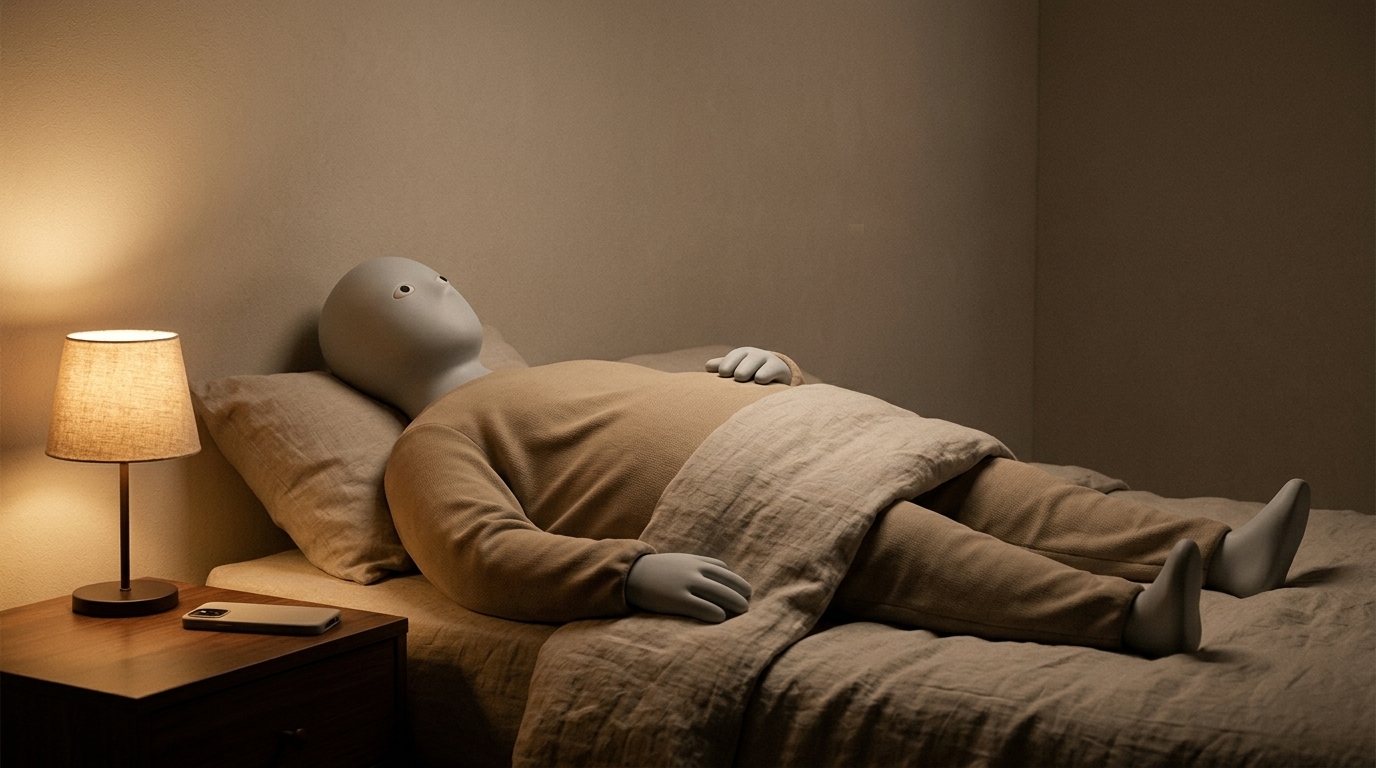
You know the feeling intimately. You’re physically exhausted. You want to sleep. And somehow your brain has decided that right now — 1:47 a.m. — is the perfect time to process every unresolved, unfinished, uncomfortable thing in your life simultaneously, in maximum detail.
- Fewer distractions. During the day, tasks, people, and obligations occupy your attention. At night, the distraction supply dries up completely — and suppressed thoughts flood the resulting silence.
- Prefrontal fatigue. Your rational, regulating prefrontal cortex is running on fumes by evening. Everything feels heavier, more urgent, more permanent than it actually is.
- No action available. Daytime thoughts can be acted on. At 2 a.m., there is nothing to do — so your brain stays stuck in the loop.
- The body is still. Movement metabolizes cortisol and adrenaline. When you’re horizontal and still, those stress hormones have nowhere to go.
- Sensory deprivation amplifies inner volume. Darkness and quiet remove competing sensory input. Whatever thoughts are present fill more space than they would during the day.
The 2 a.m. rule: The 2 a.m. version of any problem is always more catastrophic than the 10 a.m. version of the same problem. If your brain is offering you genuinely terrible news about yourself or your future in the middle of the night, it is a biologically unreliable narrator. Write it down. Deal with it in daylight.
Overthinking That Targets Specific Things
Why am I overthinking text messages and online interactions?
Digital communication strips out the three things humans rely on most to interpret meaning: tone of voice, facial expression, and body language. What’s left is raw text that your brain has to interpret without context. And when context is missing, your brain fills in the gaps — usually with assumptions that skew negative, because of that old negativity bias we talked about.
Why am I overthinking about one person specifically?
When overthinking locks onto a specific person, it’s almost always because that relationship holds significant emotional weight for you. The stakes feel high. Your brain, trying to protect you from loss or rejection, goes into surveillance mode: analyzing every interaction, looking for signs, running scenarios. The intensity of the overthinking is often proportional to how much you care.
Why am I overthinking my career and future?
Career and future overthinking sits at the intersection of three things that feel deeply high-stakes: identity (who am I?), security (will I be okay?), and social comparison (am I keeping up?). The problem is that thinking alone almost never produces career clarity. Action does. Small experiments give your brain actual data to work with. Thinking in isolation just gives your fears more oxygen.
Why am I overthinking my body and appearance?
Body-focused rumination combines social comparison, internalized cultural messaging, and personal history. If your thoughts about your body feel distressing, intrusive, or hard to control, please know that support exists across the full spectrum — you don’t need to be at a crisis point to reach out.
Overthinking vs Anxiety vs Depression: Understanding the Difference
| Experience | What it feels like | Typical thought pattern | When to seek support |
|---|---|---|---|
| Overthinking | Mentally busy, circular, exhausting | “What if X?” / “Why did I say Y?” | When consistent and affecting daily functioning |
| Anxiety | Physical tension, dread, urgency | “Something bad is coming” / “Fix this now” | When persistent and causing avoidance |
| Depression | Flat, hopeless, heavy, numb | “This won’t get better” / “I’m the problem” | When low mood lasts 2+ weeks consistently |
| Normal worry | Focused, resolves once addressed | “How do I handle this specific situation?” | Usually doesn’t need professional support |
12 Amazon Products That Support a Calmer Brain
No supplement or weighted blanket turns off overthinking like a light switch. But the right tools can meaningfully support your nervous system, improve sleep quality, and give your brain better ways to process. All 12 picks below are available on Amazon.
Supplements, journals, and sleep tools can meaningfully support a calmer nervous system — but they work best alongside actual practices like therapy, journaling habits, and sleep hygiene. Think of them as co-pilots, not autopilots.
FAQs — Your Most-Asked Overthinking Questions, Answered Honestly
What to Actually Do About It — A Practical Summary
| Strategy | Best for | Effort level | Time to effect |
|---|---|---|---|
| Journaling (CBT-style) | Externalizing thoughts, challenging distortions | Low barrier | Immediate relief; deeper change over weeks |
| Mindfulness meditation | Observing thoughts without fusing with them | Medium — needs consistency | Noticeable after 2–4 weeks daily |
| Therapy (CBT or ACT) | Deep, lasting change in thought patterns | Time and money commitment | Significant change within 8–12 sessions |
| Sleep hygiene | Nighttime overthinking, emotional regulation | Easy habits | Noticeable in first week |
| Phone-free wind-down | Late-night spiraling, social comparison | Hard at first, then easy | Immediate sleep quality improvement |
| Physical exercise | Metabolizing stress hormones, mood | Medium effort | Immediate benefit; lasting with consistency |
| Breathwork | Acute anxiety and spirals in the moment | Very easy once learned | Immediate physiological calming |
| Supplements | Supporting nervous system alongside other tools | Easy | 2–4 weeks for consistent benefit |
A Few Last Honest Words
If you’ve read this far, it’s probably because overthinking is genuinely affecting your life — your sleep, your relationships, your ability to make decisions, your sense of self. That’s worth taking seriously. Not with shame, not with the frantic energy of trying to “fix yourself,” but with the same patience you’d offer a good friend who told you they were struggling with the same thing.
You overthink because you’re human. Because you care about things. Because you’ve had experiences that trained your brain toward vigilance. Because the world you live in — with its pinging notifications and curated comparison feeds and 24/7 connectivity — is genuinely not designed for a calm, settled mind.
None of that means you’re stuck here forever. The brain is genuinely plastic. Patterns can change. Thought habits can be unlearned and replaced. People get substantially better from chronic overthinking all the time — usually not by willpower alone, but by combining better tools, better support, and better self-understanding.
Start small. Pick one thing from this article — one technique, one product, one conversation with a professional — and actually do it. Not everything. Just one thing.
That’s how change actually happens. Quietly, consistently, one small choice at a time.
Your brain isn’t broken. It’s just very, very busy.
The fact that you’re asking “why am I overthinking?” is already the beginning of something. Awareness always comes first. What comes next is up to you — but you don’t have to figure it out alone.
This article is for informational and educational purposes only. It is not a substitute for professional mental health advice, diagnosis, or treatment. If you are experiencing persistent distress, please reach out to a qualified therapist, psychologist, or your GP. In the UK, you can self-refer to NHS Talking Therapies. In the US, Psychology Today’s therapist finder is a reliable starting point.
